How to Journal Without Writing: 12 Gentle & Creative Ideas
Don't feel like writing? Learn how to journal without writing using photos, stickers, collage, doodles, keepsakes and other gentle ideas.
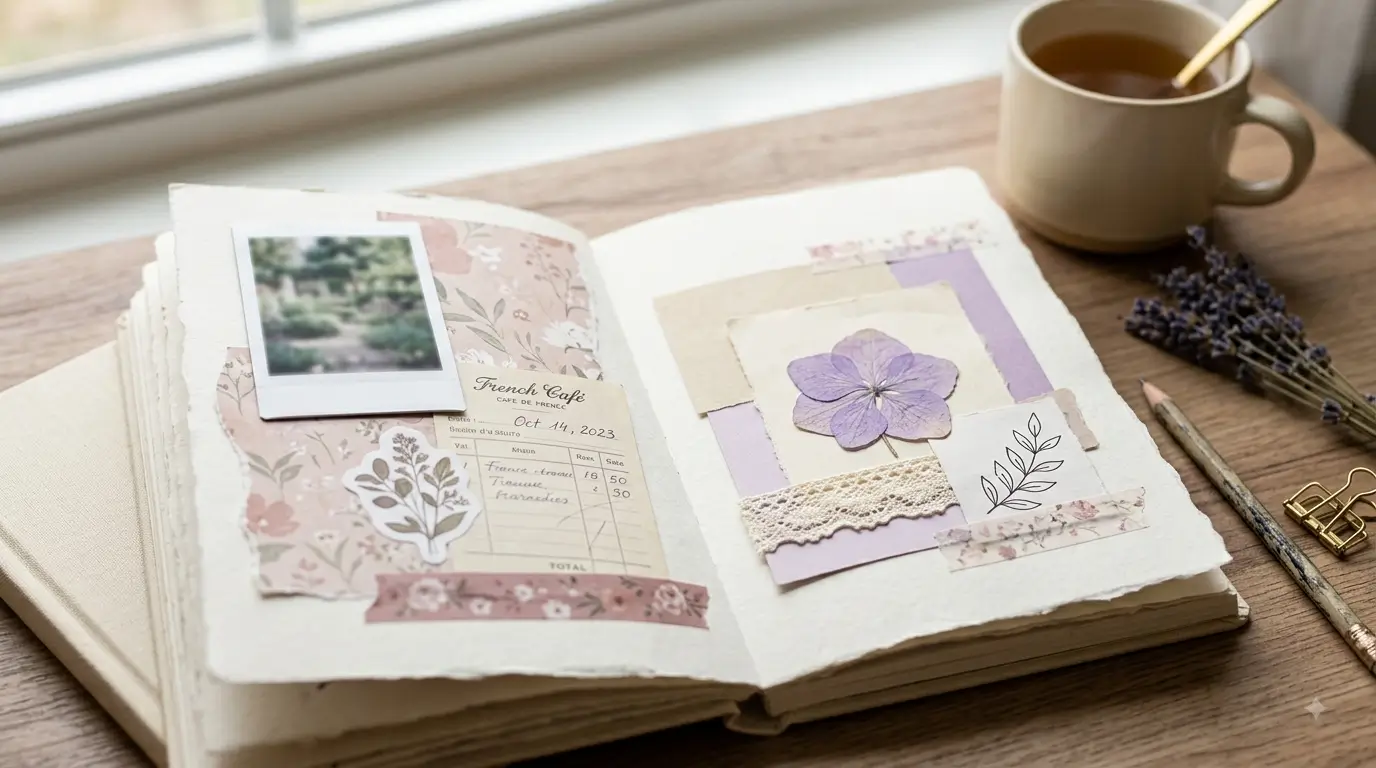
Some days, opening a journal feels comforting. On other days, even the thought of filling half a page can feel like work. If you’re wondering how to journal without writing, there are gentler ways to keep using your journal without forcing words.
Your mind might just be tired, or perhaps nothing particularly interesting happened. You could have plenty of thoughts but no desire to turn them into neat sentences. Or maybe writing has simply never been your favourite way to express yourself.
That doesn’t mean you have to close your journal.
Journaling can feel much lighter when you stop expecting every page to be filled with sentences. Your journal can hold photographs, scraps of paper, colours, doodles, stickers, little memories and unfinished thoughts just as easily as it can hold paragraphs.
There is no rule saying every journal page needs to tell a complete story.
Sometimes, keeping a tiny piece of the day is enough.
Can You Journal Without Writing?
Not at all.
When most of us think of traditional journaling, we picture pages of handwritten thoughts, reflections or diary entries. But really, a journal can just be a space where you collect things that mean something to you.
That might be your thoughts.
But it could also be a movie ticket you wanted to keep, a photograph from an ordinary afternoon, a colour combination you loved, packaging from your favourite café, a pressed flower, a drawing or one sticker that somehow captures your mood.
Journaling without writing can be especially helpful on days when you still want the comforting ritual of opening your notebook but don’t have the energy for a full entry.
And your page doesn’t have to look artistic either.
A crooked receipt taped onto a page with today’s date beside it still counts.
If You Don’t Feel Like Writing, Start With What Feels Easy
Before searching for the perfect journaling activity, ask yourself one simple question:
What feels easiest today?
If you feel creative, you might make a collage. On a tired day, pasting a single photograph might be enough. When you feel restless, covering a page in colours or simple patterns can be an easy place to start. And if you just don’t want to deal with words, reach for stickers, photographs, scraps of paper or doodles instead.
There is no “better” version of journaling. The best option is usually the one that makes you actually want to open your journal.
| If you feel… | Try… | Effort |
| Too tired to write | Paste one photo or keepsake | Very low |
| Uninspired | Build a sticker page | Very low |
| Creative | Create a small collage | Medium |
| Nostalgic | Make a memory page | Low–medium |
| Restless | Doodle or create patterns | Low |
| Playful | Try a junk-journal-style page | Medium |
| Unsure what you feel | Create a colour page | Low |
| Sentimental | Make a keepsake pocket | Low |
| Visually inspired | Use patterned papers | Low–medium |
| Short on time | Save one tiny piece of your day | Very low |

12 Ways to Journal Without Writing
1. Paste Something From Your Day
One of the easiest journal ideas without writing is simply keeping something you would normally throw away.
A café receipt. A bus ticket. A tag from something you bought. A tiny piece of packaging. A ticket from a movie or event.
Paste it onto the page and add the date only if you want to.
You don’t even have to explain why you kept it.
Months later, an ordinary receipt can sometimes bring back more details than a carefully written journal entry: the drink you ordered, who you were with, where you went afterwards, or what that particular season of life felt like.
Small objects have a funny way of remembering things for us.
2. Make a Sticker Page
Sometimes you don’t need a theme or a purpose.
Choose a few stickers you like and arrange them on the page.
They could reflect your mood, the season, something you’re currently interested in or absolutely nothing at all.
You can build the entire page around one large sticker or fill the space with lots of tiny ones.
And if you’ve been saving beautiful stickers because you’re waiting for the “perfect” page, this might be a good reason to finally use them.
A journal is a lovely place for things you enjoy looking at.
3. Create a Small Collage
You don’t need professional art supplies to make a collage.
Use magazine cut-outs, old wrapping paper, printed pictures, paper scraps, packaging, patterned paper or anything else you already have.
Choose pieces because of their colours, textures or simply because they catch your attention.
You could create a page inspired by your mood, a specific season, things you love right now, or just piece together a completely random collection.
The page doesn’t need to mean anything profound.
Making something simply because it feels pleasant is reason enough.
4. Borrow a Little From Junk Journaling
Junk journaling can be wonderfully freeing because everyday materials become part of the page.
Instead of beginning with a completely blank sheet, build one from things you’ve collected.
Try layering a few scraps of paper, adding a ticket, or taping in a product label. You could include a tiny photograph, fold in some patterned paper, or finish it off with a stamp or sticker.
You can leave it exactly like that.
We’re not going deeply into different types of journaling here, but borrowing a few ideas from junk journaling can make an ordinary notebook feel much more playful.

5. Make a Page Around One Photograph
Pick one photo from your phone and print it.
It doesn’t have to be an important photograph. It could just be your breakfast, your messy desk, the sky on your way home, a flower you noticed, or a blurry snapshot from an evening out.
Paste it onto the page and let the photograph be the entry.
Photo-based journaling can be particularly lovely when you want to remember ordinary life, not just birthdays, holidays and big events.

6. Fill the Page With Doodles or Patterns
You don’t need to know how to draw.
Try repeating simple shapes across the page.
Flowers, stars, waves, hearts, squares, leaves, spirals or little clouds all work.
Or draw a few lines and fill the spaces between them with patterns.
The point isn’t to create good art.
And if half the page turns out messy?
Leave it messy.
Your journal isn’t an art portfolio.
7. Use Colours Instead of Sentences
If words don’t appeal to you, colours offer another way to create a page.
Choose a few shades that seem to match your day.
You might associate yellow with excitement, blue with quietness, red with frustration or green with feeling settled.
But you don’t have to follow traditional colour meanings.
Choose what makes sense to you.
Fill small sections of the page, create abstract shapes, make colour swatches or draw overlapping lines.
Over time, you may even develop your own little visual language for different moods and memories.

8. Create a Quote Page
You may not feel like explaining your thoughts, but sometimes you come across a sentence that already says something you want to remember.
Print, paste or place a favourite quote, affirmation or short phrase in the centre of your journal page.
Then let the rest of the page be visual.
Add paper, stickers, borders, photographs, doodles or dried flowers around it.
Or leave plenty of blank space.
You don’t need to turn the quote into a written reflection. It can simply be something you wanted to keep.
9. Make a Visual “Things I Like Right Now” Page
Your journal doesn’t always need to explore deep emotions.
It can also preserve the very ordinary things making life enjoyable.
Think about what you’re currently watching, eating, listening to, wearing, reading, learning or looking forward to.
Instead of writing a long list, represent them visually.
Paste a tiny picture of a favourite snack, print the cover of a book you’re reading, add a colour that reminds you of a favourite outfit or include a little image connected to the song you keep replaying.
These pages become surprisingly interesting later because our favourites change more often than we realise.
10. Make a Memory Pocket
Tape or glue a small envelope or folded paper pocket onto a journal page.
Then use it to keep tiny things you don’t want to lose.
Slip in a ticket, a stray photograph, a dried flower, a small label, a little card, or a paper keepsake from somewhere meaningful.
You don’t have to arrange everything beautifully on the page. Sometimes simply creating a safe little place for those memories is enough.
This is also a useful answer if you’re wondering what to put in a journal besides writing but don’t want to permanently glue everything down.

11. Play With Patterned Paper
Patterned paper can completely change a blank journal page without requiring you to write anything.
Cut or tear pieces into different shapes and layer them.
You could use floral prints, checks, stripes, old gift wrap, handmade paper, newspaper textures or printable patterns.
Cover the whole page or leave plenty of blank space around them.
There doesn’t have to be a finished design in mind before you begin.
Sometimes choosing, tearing and arranging paper is the entire journaling activity.
12. Make a Page That Has No Purpose
This may be one of the most important ideas on this list.
Not every journal page needs to help you grow, track a habit, organise your life, understand your emotions or become something beautiful enough to photograph.
Sometimes you can simply make a page.
Stick some random paper onto it, or use a pen you haven’t touched in months. Add a sticker. Draw badly. Tape down something completely ordinary. You can even stop halfway through if you lose interest.
Your journal is allowed to contain unfinished, imperfect and completely pointless pages.
In fact, those pages can make it feel much more like yours.
What Can You Put in a Journal Besides Writing?
Once you stop thinking of a journal as a notebook that must be filled with sentences, the possibilities become much wider.
| Paper & keepsakes | Visual elements | Personal memories |
| Receipts | Stickers | Photographs |
| Tickets | Doodles | Postcards |
| Wrapping-paper scraps | Colour swatches | Notes from others |
| Product labels | Printed illustrations | Pressed flowers |
| Patterned paper | Magazine cut-outs | Travel keepsakes |
| Tags | Stamps | Small cards |
| Packaging | Washi tape | Event memorabilia |
You certainly don’t need all of these.
Your journal might contain words most days and only the occasional ticket or photograph.
Or it might slowly become thick with scraps, pictures and tiny reminders of your life.
Both are journals.
What If You Want to Write but Don’t Know What to Write?
That’s actually a slightly different problem.
You may be perfectly happy to write but find yourself staring at a blank page because you can’t think of anything to say.
In that case, prompts and simple questions can be much more useful than finding alternatives to writing.
We’ll explore that separately rather than trying to squeeze two different journaling problems into the same guide.
Your Journal Doesn’t Need to Be Pinterest-Perfect
Creative journaling comes with its own little trap.
You stop worrying about writing a beautiful journal entry and start worrying about making a beautiful journal spread instead.
Then suddenly, the stickers need to match, the photographs need to have the same colours, your handwriting looks wrong, and that torn piece of paper just isn’t sitting where it looked better in your head.
You don’t have to replace one set of journaling rules with another.
A slightly crooked photograph is fine, and so is unevenly torn paper. It’s even okay to end up with a page you don’t particularly like once it’s finished.
You’re keeping a journal, not building a portfolio.

You Don’t Have to Journal Every Day Either
There’s also another option worth mentioning.
You can simply not journal today.
Missing a day doesn’t ruin your journal.
Missing a week doesn’t ruin it either.
You don’t need to fill the empty dates afterward or apologise to your notebook before beginning again.
Journaling should give you somewhere to return to, not another streak you’re afraid to break.
If you’re wondering how to journal when you don’t feel like writing, journaling without writing can be one option.
Taking a break can be another.
Make Your Journal Easier to Return To
One reason people lose interest in journaling is that they quietly create too many rules around it.
We tell ourselves the handwriting must look nice, every page should be filled, and the entries have to mean something. We start believing the journal has to look cohesive or that we need to use it every single day.
Instead, try giving yourself one much simpler rule:
My journal can hold whatever I want to keep today.
Some days that may be several pages of thoughts.
Another day it might be a sticker, a photograph and the wrapper from something you ate.
That flexibility is what can make a journal feel like a comforting part of your life rather than another responsibility.
A Gentle Place to Begin
The next time you open your notebook but words aren’t coming, don’t immediately ask:
“What should I write?”
Try asking:
“What would I like to keep from today?”
It might be a photograph, the little paper bag from a bakery, a swatch of colour, or a flower you found on a walk. Or it could be absolutely nothing.
Your journal doesn’t need words on every page to tell the story of your life.
Sometimes the little things you keep say enough on their own.
Visit The Best Journals to learn more about our approach to simple, gentle journaling.
Frequently Asked Questions
Do I need a special kind of journal for this?
No. If you’re learning how to journal without writing, you can use an ordinary notebook, sketchbook, scrapbook or even a ring binder. What matters more is having enough space for the things you enjoy using, such as photographs, stickers, tickets, scraps of paper, doodles or small keepsakes.
Can I combine writing and non-writing pages in the same journal?
Absolutely. You don’t have to choose one journaling style and stick to it. If you’re exploring how to journal without writing, you can use photographs, collage, colours or keepsakes on some pages and write normally on others. Your journal can change with your mood, energy and what you want to remember that day.
Can I use only pictures and stickers in my journal?
Yes. A journal doesn’t have to contain long written entries to be meaningful. Visual pages can preserve memories, interests, moods and everyday moments just as written pages can.
Is junk journaling the same as journaling without writing?
Not exactly. Junk journaling often uses paper scraps, packaging, tickets, ephemera and layered decorative elements, but it can still include written notes or longer entries. Journaling without writing is broader and can include photos, colours, doodles, stickers, keepsakes and other visual methods. You can borrow junk-journaling techniques without making your whole journal a dedicated junk journal.
Do I need artistic skills to try journaling without writing?
No. Your journal doesn’t need to look polished or artistic. Simple doodles, roughly torn pieces of paper, photographs, stickers or one saved receipt can be enough. The page only needs to feel meaningful or enjoyable to you.
Can journaling without writing still help me remember my day?
Yes. Photographs, tickets, colours, receipts, stickers and small keepsakes can act as memory cues. Even without a written explanation, seeing those objects later can bring back details about where you were, what you were doing or how that period of your life felt.